

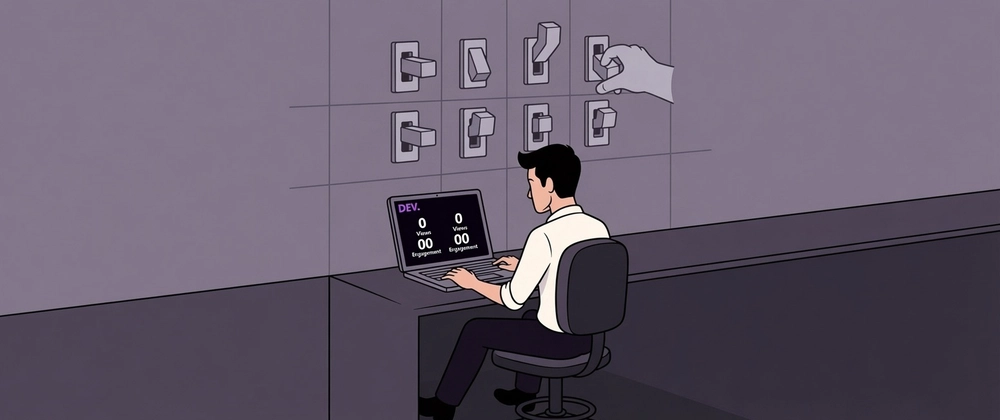
This is the third piece in a sequence. The first asked whether Sloan had flagged anyone else — it had. The second documented what I found out — Slo...
For further actions, you may consider blocking this person and/or reporting abuse


Hey @dannwaneri, I'm on the DEV team and deal with the challenge submissions directly. I just double checked and can confirm your Game Jam submission was in the pool we sent to the judges.
Thank you for checking and confirming directly . That's the answer I needed. Good to know it was in the pool...
@francistrdev @xulingfeng @jess @ben — third piece in the sequence. Documents what happened after the Sloan articles: the LLM visibility article deleted after the first flag, the Qodo article flagged despite full disclosure from the start, the Game Jam submission invisible in the submissions list after first-hour engagement. Can't prove suppression. Can document the pattern.
The closing question is for @jess and @ben specifically: if there's an account-level flag that affects distribution, should authors be told when it's active? @xulingfeng had to run a controlled experiment to find out. That's the thing worth answering.
@fm @sylwia-lask @bumbulik0 — you were all part of the earlier threads. This is where the story landed.
Seems like you are flagged, maybe @francistrdev can you check it?
I can confirm you were not flagged (at least on my end). Thanks for the reminder.
This happens to my article on "A Developer using AI, What could possibly go wrong" and it didn't appear on the tag "latest" list. After that post, everything went back to normal. To be fair, I would assume it was a bug due to the Rails upgrade I believe, but can't confirm.
Appreciate you checking and being direct about it. The Rails upgrade explanation for the submissions list is the first concrete alternative I've heard and if it happened to your article too, that's a bug worth DEV.to acknowledging publicly so authors know it's not them....
The broader pattern I documented - the engagement drop across multiple article types in the same two-week window still doesn't have an explanation. But ruling out account-level flagging on your end is useful data. That narrows it.
The question about notification still stands though. Whether it's a flag or a bug, authors finding out through a comment thread or not at all is the gap worth fixing...
Can you clarify on which articles specifically, so I can take a look at it? Thanks!
Sure. The articles where I noticed the pattern:
LLM visibility article (first run) — published before the Sloan articles, was gaining traction, deleted after the first Sloan flag. Republished June 23 as The LLM Visibility Tools Cost $79/Month. Mine is Open Source — underperformed compared to the first run.
Qodo article — Claude Code Wrote the PR. Here's What the Code Review Actually Caught — published June 17, flagged by Sloan the same day despite having full AI disclosure from the start.
Proof of Human — Proof of Human: I Built a Reverse Turing Test After Getting Flagged as AI — June Solstice Game Jam submission. First-hour engagement from tags, then flatlined. Wasn't visible in the challenge submissions list when I checked.
The submissions list issue you mentioned with the Rails upgrade might explain number 3. Numbers 1 and 2 are the ones I'm less sure about.
Appreciate the mention, Dann! Just a quick update from my end — after Francis unflagged my account, everything's been running normally. The articles I've published since then have been showing up in feeds, getting organic reach, no more unexplained suppression.
So the fix did work. The question you're raising is still valid though — how many people are walking around with active flags and no idea? That's the part worth fixing.
Solid third piece.
I would recommend reaching out to me since I have been mostly active and have been using moderation to the fullest and fair extent. It IS possible that someone out there are flagging accounts without warning, but as @jess mention, I am the most active currently on the platform and it is a good idea to reach out to me on the "Ask a DEV Mod" post about the issue just in case if it was me. If not, I usually direct them to contact the actual team to investigate.
Thanks for everything you do, Francis. You've genuinely been the most active and fastest-responding mod we've seen around here. Appreciate you keeping the door open — people know where to find you if something's up.
I appreciate it! also thanks for the comment you left on my recent post on thinking I am behind on things. I will get around to respond to everyone on there when I can. Feel free to @ me whenever you need me in an appropriate manner!
Excellent follow-up. I especially appreciate how you treat this like an engineering investigation: you document the sequence, identify confounding variables, compare repeated outcomes, and avoid claiming causation where the evidence only supports correlation.
From a systems perspective, this is fundamentally an observability problem. If multiple moderation warnings can produce an account-level state that changes feed, search, or challenge visibility, authors should be able to see when that state is active, what triggered it, and how it can be reviewed. Silent distribution changes make legitimate moderation indistinguishable from ranking variance or platform failure.
The controlled experiment described by xulingfeng makes the transparency gap even harder to dismiss. Moderation can be imperfect, but invisible moderation state leaves authors unable to debug, appeal, or even understand what is happening.
"Observability problem" is the right frame and it's more actionable than "suppression." Suppression implies intent.
Observability is a system property either the state is visible to authors or it isn't and right now it isn't. UnitBuilds just confirmed that moderators can't see the computed rep score either, which means neither authors nor mods have visibility into the metric that determines feed distribution.
Everyone is debugging blind. That's not a moderation policy problem . it's an instrumentation gap that makes the system untrustworthy even when the people running it are acting in good faith.
Well said—the distinction between suppression and observability is important because one assumes motive while the other identifies a concrete system property. If the computed reputation score influences feed distribution, it should be exposed through an explainability layer showing the score, contributing signals, recent changes, and the reason a post’s reach was limited. Moderators should also have access to the same diagnostic data, with appropriate privacy controls and audit logs. Without that instrumentation, support teams cannot distinguish a bug, a ranking penalty, stale data, or legitimate moderation behavior. The people operating the system may be acting entirely in good faith, but the architecture still produces an untrustworthy experience when every participant is debugging blind.
That's a feature spec not just a design principle. Score, contributing signals, recent changes, reason for reach limitation — author-facing with a moderator mirror and audit logs. If that existed, this entire thread wouldn't have needed to happen. xulingfeng wouldn't have needed to run a controlled experiment. Francis wouldn't have been operating on a dashboard that hides the metric his decisions affect. I wouldn't have spent two weeks wondering if the pattern I was seeing was real.
The instrumentation gap is fixable. What this thread has produced — UnitBuilds on the Forem internals, your spec, Francis confirming the low quality mark is actually enough to write a concrete proposal. That might be worth doing.